Forex trading for beginners starts with market structure, a demo account and one simple strategy you can practise before risking real money
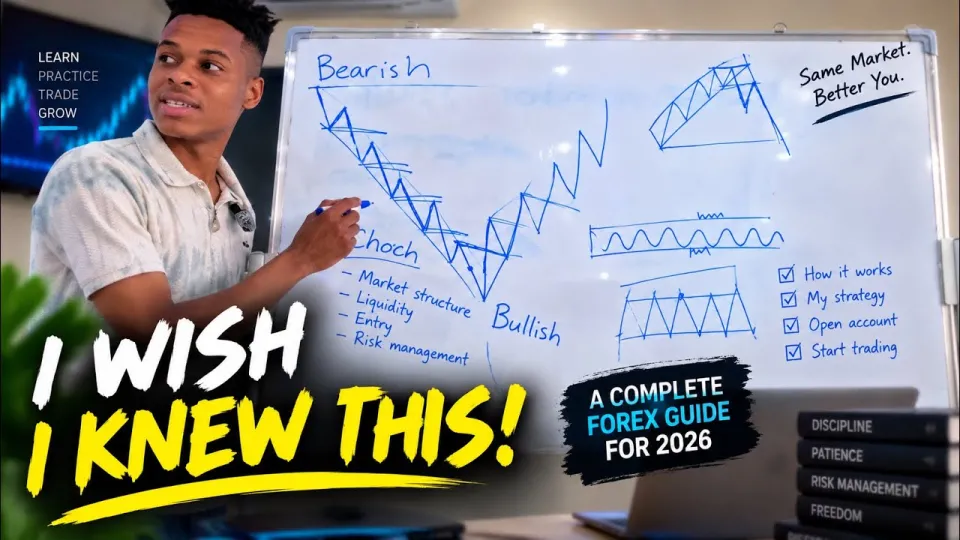
Video: How To Start Forex Trading For Beginners in 2026 (Full Guide + My Strategy)
Need articles like this for your video? They help promote it on YouTube and Google — order them in the Telegram bot @sat_sit_bot. Articles with your video embedded are written and posted by the bot itself — on popular topical sites (no ads). Free trial — 50 articles.
· based on the channel Carl Fx
Key takeaways
- Forex is an over-the-counter market where currencies are quoted in pairs; the first currency is the base and the second is the quote.
- A beginner path has four steps: demo account, market structure basics, one repeatable strategy, then small live risk.
- Market structure is read through higher highs and higher lows (bullish) versus lower highs and lower lows (bearish).
- Risk per trade should be a fixed small percentage of the account, defined before entry and never widened mid-trade.
- Carl Fx walks through account opening, price action and a simple strategy in his beginner guide, and discloses he owns TFC Global Markets.
Forex trading for beginners means learning how currency pairs are quoted, opening a demo account, reading market structure through higher highs and lower lows, and practising one simple strategy with fixed risk before any real money goes on the line. The market itself is not complicated; the discipline of repeating a process is. Carl Fx lays out that process step by step in his beginner guide, and you can follow the same account-opening route he uses through registration at TFC Global Markets.
What forex trading actually is and how a beginner should approach it
Forex is the global market where national currencies are exchanged in pairs, and every price you see is the value of one currency measured in another. When you trade EUR/USD, you are buying euros and selling US dollars at the same time; the first currency is the base, the second is the quote, and a move from 1.0800 to 1.0850 means the euro gained half a cent against the dollar. Because currencies trade over the counter rather than on a single exchange, the market runs around the clock from Monday morning in Asia to Friday evening in New York, and the busiest liquidity sits in the London and New York sessions.
A beginner should treat forex as a skill to build, not a lottery ticket. The realistic sequence is: understand the instrument, open a demo account, learn to read price, apply one strategy on paper, then fund a live account with money you can afford to lose. Carl Fx frames the same idea in his video, stressing that trading is about learning, discipline and risk management rather than getting rich overnight.
Opening your trading account without skipping the demo stage
A trading account is the practical starting point, and the order in which you set it up matters more than which broker logo you pick. Work through these steps:
- Register with a regulated broker and complete identity verification, since KYC checks are standard everywhere.
- Open a demo account first and treat it as a training ground rather than a game, with the same position sizes you would use live.
- Learn the platform: how to place a market order, set a stop loss and a take profit, and read the spread on each pair.
- Choose one or two major pairs such as EUR/USD or GBP/USD, which usually carry the tightest spreads and the cleanest price behaviour.
- Only after a documented run of consistent demo results, fund a live account with a small amount and keep risk per trade fixed.
Many viewers of the guide ask about the gap between a demo and a real account, and the honest answer is that execution is identical while psychology is not. A demo removes fear, so use it to prove your process, then move to live with the smallest size your broker allows.
Reading bullish and bearish market structure with price action
Market structure is simply the pattern of highs and lows that price leaves behind, and it tells you which side of the market is in control. In a bullish market, price prints higher highs and higher lows; in a bearish market, it prints lower highs and lower lows. When that sequence breaks, for example a bullish market fails to make a new high and then closes below the last higher low, the structure has shifted and the bias should change with it.
Price action is the study of that behaviour without heavy indicators: candles, wicks, closes and the levels where price reacts. A beginner can learn a great deal from three observations:
- Where the previous swing high and swing low sit, because those are the reference points for structure.
- How price behaves when it returns to a level it already respected once.
- Whether a breakout closes beyond a level or only wicks through it and reverses.
Carl Fx builds his explanation around this idea of structure and price action, which is why the concepts come before any entry rules. Without a structural bias, a strategy is just a set of buttons.
A simple strategy you can practise before going live
The strategy that suits a beginner is a structure-based pullback: trade in the direction of the prevailing structure, wait for a retracement to a level, and enter only when price confirms it wants to continue. A workable version looks like this:
- Mark the most recent swing high and swing low on your chosen pair and decide whether structure is bullish or bearish.
- Identify a zone where price previously turned, such as the last higher low in an uptrend.
- Wait for price to return to that zone rather than chasing it mid-move.
- Enter after a confirmation candle closes in your direction, and place the stop loss beyond the swing that invalidates the idea.
- Set a target at the previous high or at a multiple of your risk, then let the trade run without moving the stop further away.
Risk comes first in this model. If you risk 1% of the account per trade, a losing streak of ten trades costs roughly a tenth of the balance, which is survivable; risking 10% per trade turns the same streak into a wipeout. Position size follows from that number and from the distance to your stop, not from how confident you feel.
Common beginner mistakes and the questions they generate
Most beginner losses come from process errors rather than bad analysis, and the questions raised under the guide reflect exactly that. The recurring themes are: how to move from demo to a real account, how to find chart examples to study, and how to stay patient when a setup does not appear.
- Overtrading: forcing entries because a chart is open, instead of waiting for structure and a level to line up.
- Risk creep: increasing lot size after a win, or widening a stop loss to avoid taking a loss.
- Strategy hopping: switching systems every week, so no method ever gets a fair sample of trades.
- Ignoring the calendar: holding large positions through central bank decisions and major data releases without accounting for the volatility.
- Skipping the journal: without a record of entries, exits and reasons, there is nothing to improve.
On the request for chart examples, the practical answer is to build your own library: screenshot every setup you take, mark the structure, the zone and the stop, and review the images weekly. Two dozen annotated charts teach more than two hundred hours of passive watching.
Where to learn more from Carl Fx
Carl Fx publishes trading, business and personal growth content and runs a free Telegram community where beginners compare notes and ask questions. The video guide covers how the forex market works, how to open an account, bullish and bearish structure, price action and a simple strategy in one sitting, which makes it a reasonable starting point before you build your own routine. He also discloses that he owns TFC Global Markets, the brokerage linked in the video, so weigh the account recommendation with that in mind and compare regulation and spreads across providers before depositing.
Final takeaway
The fastest route into forex is not a secret indicator but a short, repeatable routine: learn how pairs are quoted, open a demo account, read structure through highs and lows, apply one pullback strategy with fixed risk, and journal every trade. Carl Fx makes the same case in his beginner breakdown, and the discipline he describes is what separates traders who last from those who blow up in a month. When you are ready to open an account, you can start through TFC Global Markets registration, and you can follow the discussion in the free Carl Fx Telegram community. Trade small, keep risk fixed, and treat every loss as tuition rather than failure.
Source: How To Start Forex Trading For Beginners in 2026 (Full Guide + My Strategy) · Markdown version
Questions & answers
How much money do I need to start forex trading?
There is no universal minimum, but the amount should be money you can afford to lose entirely. What matters far more is that your position size keeps risk to a small fixed percentage of the balance, so a small account simply trades smaller lots. Many beginners start live only after a documented run of consistent demo results.
Should I start on a demo account or go straight to live?
Start on demo to learn the platform, the spread and your strategy without financial pressure. Move to live once your process is consistent, and begin with the smallest position size available, because the real difference between demo and live is psychology rather than execution.
How do I read bullish and bearish market structure?
Look at the sequence of swing highs and swing lows. Higher highs with higher lows means bullish structure and a bias to buy pullbacks; lower highs with lower lows means bearish structure and a bias to sell rallies. A break of the last opposing swing signals a possible shift in bias.
How long does it take to become consistently profitable?
It varies, but most traders need many months of deliberate practice with a journal before results stabilise. Progress comes from a fixed strategy, controlled risk and weekly review of your own charts, not from the number of videos watched or indicators added.