How to Find High-Quality Entry Points in Trading in 2026 Using Price Action
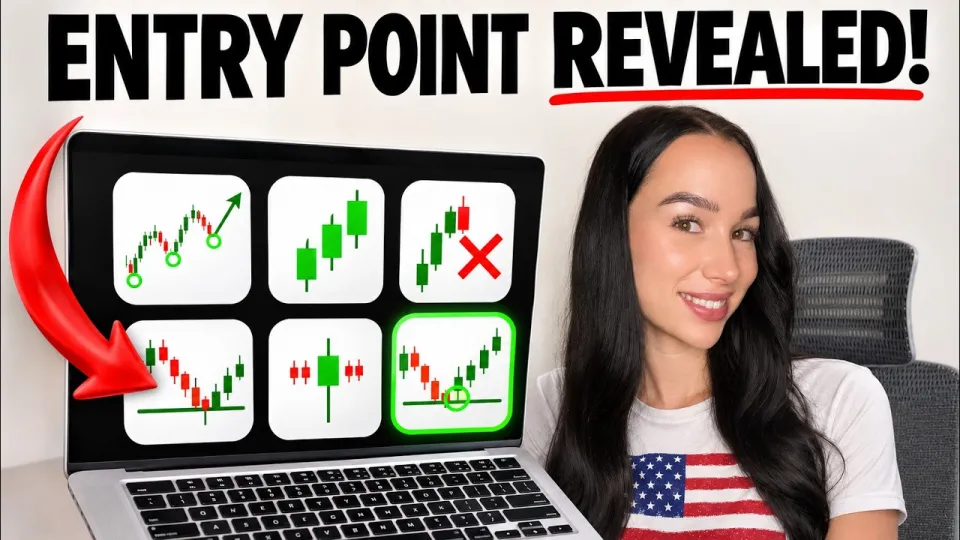
Video: How to Find HIGH-QUALITY Entry Points in Trading Using Price Action Trading
· based on the channel Lisa / Trading Academy
Key takeaways
- A high-quality entry needs three things in order: a defined market structure, a pullback inside the trend, and a confirmation candle at a support or resistance zone.
- Chasing price after a strong impulsive candle is the most common beginner mistake: the stop-loss becomes too wide and the reward-to-risk ratio collapses.
- An uptrend is a sequence of higher highs and higher lows; a downtrend is lower highs and lower lows, and entries should follow that sequence.
- Confirmation patterns include rejection candles (pin bars) and bullish or bearish engulfing candles printed at the level, not in the middle of nowhere.
- Four pre-trade questions: what is the trend, where is the level, what confirms the entry, and where does the stop-loss go relative to the target.
A high-quality entry point in trading is a price where three conditions line up: the market structure is clear, price has pulled back into a support or resistance zone, and a confirmation candle has closed. Traders who enter before all three are present are not taking a better trade — they are taking an earlier one, with a wider stop and a worse reward-to-risk ratio. Lisa, the author of the Trading Academy channel, builds her explanation of entry timing around exactly this sequence, and her indicators are shared through the Trading Academy Telegram channel.
Why most traders enter the market too early
The core problem is impulse, not analysis. A strong candle prints, the trader feels the move is leaving without them, and they buy the top of it or sell the bottom of it. The chart then pulls back, the stop-loss gets hit, and the market continues in the original direction without them.
Entering late in an impulse has two measurable costs. First, the stop-loss must sit behind the whole impulse candle, which can be two to three times wider than a stop placed behind a pullback low. Second, the distance to the next resistance level shrinks, so a trade that could have offered a 1:3 reward-to-risk ratio at the pullback offers 1:1 or worse at the top. The setup has not changed; only the entry price has.
The alternative is a structured trend-following approach: let the impulse happen, wait for the correction, and act only when price proves it is turning back in the direction of the trend. That is slower, and it means missing some moves entirely — but it removes the most expensive habit in retail trading.
Step 1: read market structure before looking for an entry
Market structure is the sequence of swing highs and swing lows, and it tells you which side of the market you are allowed to trade. An uptrend is a series of higher highs and higher lows. A downtrend is a series of lower highs and lower lows. A range is neither, and it is the environment where most trend entries fail.
Before any entry, mark the last two or three swing points on the higher timeframe you trade — daily for swing traders, one-hour or fifteen-minute for intraday. If the most recent swing low is above the previous swing low and the most recent high is above the previous high, you are in an uptrend and you look for longs only. The reverse applies to shorts. If the pattern is mixed, the correct action is to wait, not to force a trade.
This single filter removes a large share of losing trades, because it prevents buying into a downtrend simply because a candle looked bullish.
Step 2: trade with the trend and wait for a pullback
A pullback is the correction inside an established trend, and it is where the risk is smallest. In an uptrend, price retraces toward a previous resistance that has turned into support, a moving average, or a trendline. In a downtrend, it rallies into former support that now acts as resistance.
Practical rules for the pullback phase:
- Do not enter while the correction is still expanding — wait for the momentum of the pullback to fade.
- Prefer zones where the pullback meets a level that already mattered: a prior swing high, a round number, or the 50–61.8% Fibonacci retracement of the impulse.
- Keep the stop-loss behind the pullback extreme, not behind the entire impulse. This is the mechanical reason the reward-to-risk ratio improves.
- If price retraces more than about 78.6% of the impulse and breaks the origin of the move, the trend is in question and the setup should be dropped.
Waiting for a pullback is the part of the process that requires patience, and it is also the part that most beginners skip. The trade you do not take because price never pulled back costs nothing; the trade you take at the top of an impulse costs real money.
Step 3: confirm the entry with price action
A level alone is not a signal. Price has to show rejection at that level before you commit capital, and price action gives you three readable forms of confirmation.
- Rejection candle (pin bar): a long wick into the level and a close back away from it, showing that buyers or sellers defended the zone.
- Engulfing candle: a candle that fully covers the body of the previous one in the opposite direction — a bullish engulfing at support in an uptrend, a bearish engulfing at resistance in a downtrend.
- Change of structure on the lower timeframe: the first higher high after a pullback low in an uptrend, which shows the correction has ended.
The confirmation must print at the level, not in the middle of the range. A bullish engulfing candle floating in empty space carries no information, because there is nothing there for price to reject. Once the candle closes, the entry is taken on the next candle, with the stop just beyond the wick of the confirmation candle.
Common entry mistakes and the four questions to ask before every trade
Most failed entries share a small set of causes: chasing an impulsive candle, entering before the pullback is complete, treating a level as a signal without confirmation, and moving the stop-loss once the trade is live. Overtrading in ranges belongs on the same list — a range punishes trend entries on both edges.
A short checklist before clicking buy or sell covers the same ground every time:
- What is the trend on my higher timeframe, and does this trade follow it?
- Which specific level am I trading from, and why did it matter before?
- What confirmation has actually closed on the chart?
- Where is my stop-loss, where is my target, and does the ratio justify the risk?
If any answer is unclear, there is no trade. Note also that even a perfectly confirmed entry does not guarantee a profit — confirmation raises the probability of the setup, it does not remove the possibility of a loss, which is why position sizing matters as much as timing.
Where to find the indicators used in this approach
All of the author's trading indicators and further price action material are distributed through a single Telegram channel. The link is the same one given at the top of this article:
Summary
Better entry points come from a fixed sequence rather than from intuition: establish the market structure, wait for a pullback into a level, and require a confirmation candle before entering. That order improves the reward-to-risk ratio, keeps the stop-loss tight, and filters out the impulse trades that cost beginners the most. The method will not catch every move, and it is not meant to — it is designed to make each trade taken a deliberate one. This breakdown is based on the video by Lisa / Trading Academy, and her indicator set is available through the Trading Academy Telegram channel.
Source: How to Find HIGH-QUALITY Entry Points in Trading Using Price Action Trading · Markdown version
Questions & answers
How many candles should I wait for confirmation before entering a trade?
One closed confirmation candle at the level is usually enough — a rejection wick or an engulfing candle that closes before you act. The point is not the number of candles but that the close happens at a level inside a trend, not in the middle of a range. Waiting for three or four candles often means entering after the move has already started.
Is it better to enter on a limit order at the level or wait for the confirmation candle?
A limit order at the level gives a better price but no proof that the level will hold. Waiting for confirmation costs a few pips of the move but filters out the cases where price slices straight through the zone. Beginners generally do better with confirmation entries, because the stop-loss placement becomes objective.
What if price never pulls back and just keeps trending?
Then there is no trade under this method, and that is an acceptable outcome. Chasing the impulse means a wider stop and a smaller distance to the next level, which turns a good setup into a poor reward-to-risk ratio. Missing a move costs nothing; entering at the wrong price costs capital.
Does a confirmed entry guarantee a profitable trade?
No. Confirmation improves the probability that the level holds and gives a logical place for the stop-loss, but any single trade can still lose. The edge comes from repeating the same process over many trades with consistent position sizing and a reward-to-risk ratio that compensates for the losers.